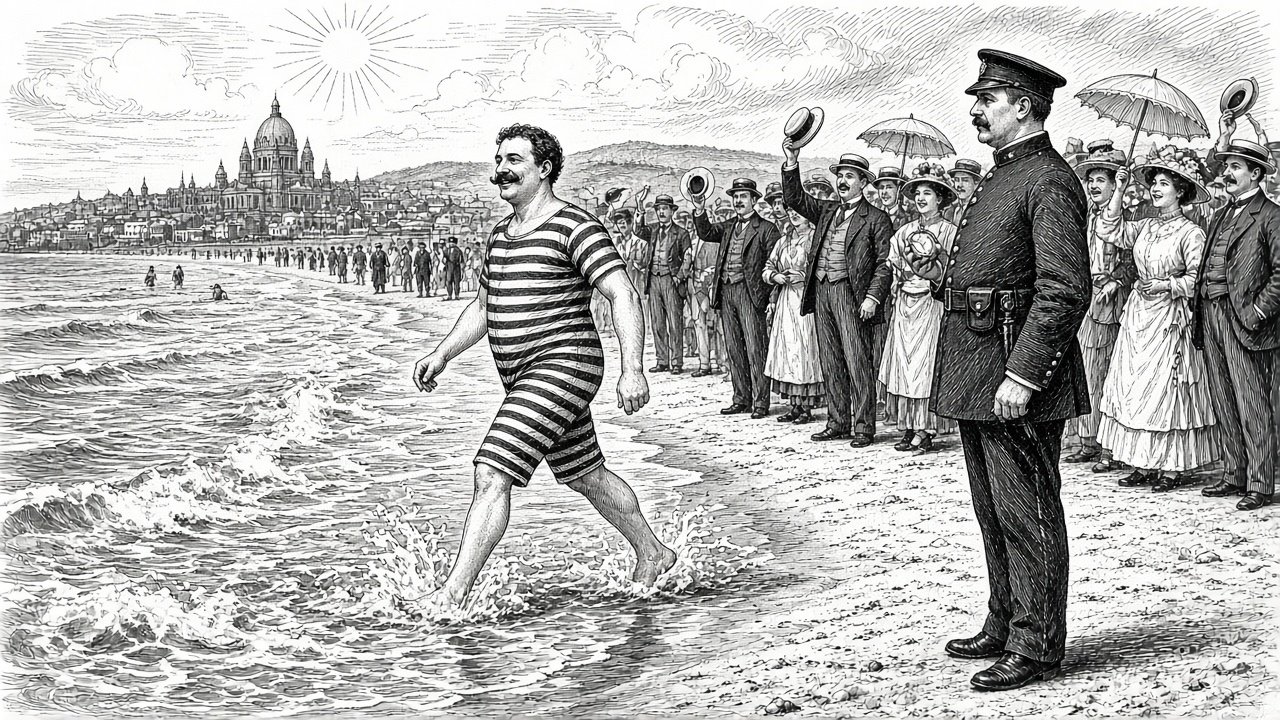
For most of the 1800s, a daytime dip at a Sydney beach could put you on the wrong side of the law. Within a few years of that changing, the beaches were packed, people who couldn’t really swim were drowning, and groups of locals were teaching themselves how to drag strangers out of rips. A century later, the red-and-yellow flags are about as Australian as it gets. Here’s how it happened, with the arguments left in.
Banned before breakfast
From 1838, bathing in Sydney’s harbour and on its beaches was banned between 6am and 8pm. The worry was decency more than safety. There were few change sheds and not many proper swimming costumes.
Enter William Gocher, an artist and newspaperman who had moved to Manly and started his own local paper. He announced in its pages that he would swim at midday, and he did, in a neck-to-knee costume. Most accounts date it to October 1902; Surf Life Saving NSW says September. The authorities ignored him twice, and he wrote that they weren’t trying very hard. On his third swim, police escorted him from the water and questioned him. No charges were laid.
Other beaches had similar protests, and police were reluctant to arrest anyone who was decently covered. In November 1903 Manly Council allowed all-day bathing, as long as you wore neck-to-knee. Gocher claimed the win, and in 1907 friends gave him a gold watch and a purse of fifty sovereigns. The catch was that crowds of new surf bathers didn’t know how to read a rip.
Who was first? Pick your beach
Organised lifesaving came before the surf clubs. A Manly Life Saving Brigade formed in December 1899. Manly Council paid two fishermen, the Sly brothers, to patrol offshore from 1903, and hired a lifeguard, Edward “Happy” Eyre, in 1905.
Then comes the oldest argument on the coast.
- Bondi’s case. The Bondi Surf Bathers’ Life Saving Club was formed by 23 men at the Royal Hotel, Bondi Junction, on 21 February 1907. The NSW Government’s heritage plaque calls it Australia’s first recorded surf lifesaving club. For about 50 years Bondi itself said 1906, until it checked the records and switched to 1907 in 2006.
- Bronte’s case. Bronte says its lifesavers organised in 1903. It points to the minutes of a 1907 meeting described as its fourth annual meeting, which were sighted in 1982, and to a document in a 1931 time capsule signed by association officials agreeing that Bronte was first. Bondi’s side replies that there are no surviving primary records for 1903.
- The verdict. There isn’t one. Manly has a claim too. Surf Life Saving Australia’s centenary history said Bondi was the first to form a formal club, while noting Manly’s 1899 group. The National Film and Sound Archive puts it simply: the argument still rages.
Everyone agrees on what came next. On 18 October 1907, clubs and other groups formed the Surf Bathing Association of New South Wales to regulate surf bathing and raise money. It became the Surf Life Saving Association of Australia in 1923 and Surf Life Saving Australia in 1991. The first surf bronze medallions, the qualification to patrol, were awarded to members from Coogee and Bondi on 2 January 1910.
A cotton reel and two hairpins
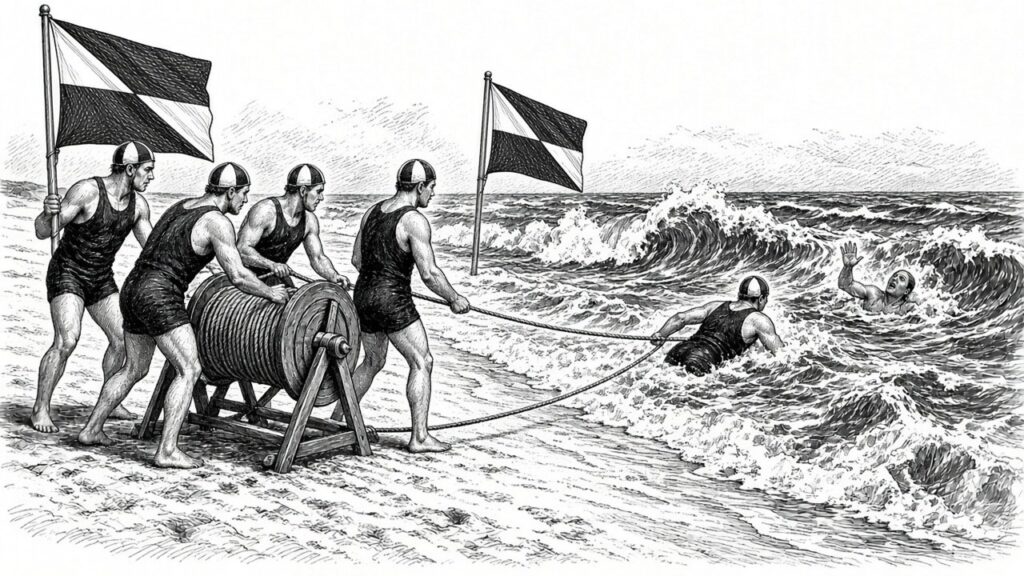
The early clubs borrowed the Royal Life Saving Society’s gear, which didn’t suit Australian surf. The fix became Bondi’s emblem. Foundation member Lyster Ormsby built a model of a beach reel from a cotton reel and two hairpins. Sergeant John Bond of Victoria Barracks built the first full-size version, and Sydney coachbuilder G. H. Olding improved it. Waverley’s library also credits clubmates Percy Flynn and Sig Fullwood. The finished reel was a cedar drum on a wooden frame with a handle, and a brake was added soon after.
A beltman wearing a belt tied to the line swam out to the swimmer in trouble, and the team on the sand reeled them both back in. When did it first get wet? The Bondi club says 23 December 1906. The National Museum of Australia’s timeline says 23 March 1907. On patrol, the reel gave way to rescue tubes from the 1970s, but it lives on in competition in the rescue and resuscitation event.
Black Sunday
Sunday 6 February 1938 was hot, and about 35,000 people were at Bondi. At around 3pm three big waves came in so close together that the water couldn’t drain back. When it did, the backwash dragged hundreds of bathers into a deep channel and out to sea.
Luckily, about 60 Bondi club members were on the beach for a club competition. They ran the seven reels already set up, grabbed floats, boards and skis, and some swam out with nothing at all. By the club’s count, about 250 people needed help, 35 were brought in unconscious and revived, and five men died. Figures vary: the next morning’s papers said nearly 200 had been swept out, and the National Museum says over 200 were rescued. It is still described as the largest mass rescue in Australian surf history.
Flags, caps and the march past
Before 1935, patrol flags were blue and white. That year red-and-yellow flags became standard, probably inspired by the maritime signal flag for “man overboard”, which is red and yellow split diagonally. The red-and-yellow quartered cap became standard patrol gear on 3 January 1939.
Carnivals turned all this drill into a show. The Surf Bathing Association held its first carnival in 1910, and the first Australian championships were held at Bondi in 1915. Tens of thousands turned up in the 1920s and 1930s. The star turn was the march past: twelve members marching in step, carrying a reel. It was borrowed from the Royal Life Saving Society, had military roots and grew bigger after the First World War. In September 1941 Australian troops held a surf carnival on the beach at Gaza, and a machine-gun battalion won the march past. In 1954 Queen Elizabeth II watched a royal carnival at Bondi. The ironman arrived in 1966.
The Duke drops in
Hawaiian Olympic swimmer Duke Kahanamoku arrived in Sydney in December 1914 to race in swimming carnivals. He hadn’t brought a board, so he shaped one from a slab of sugar pine supplied by a Sydney timber firm. It finished at about 8 feet 8 inches of solid wood. He surfed for the press at Freshwater on 24 December. He gave public displays at Freshwater and Manly on 10 January 1915.
Legend has him taking local swimmer Isabel Letham on a tandem ride at Freshwater. They did ride together, but the only newspaper report of a public tandem ride is from the Dee Why carnival on 6 February 1915. Duke wasn’t the first person to ride a board in Australia, either, since a few locals had been trying. What he did was show big crowds what was possible, and boardriding took root inside the surf clubs. His board eventually went to local rider Claude West, who gave it to the Freshwater club in 1953. The club still has it.
Women on patrol, 1980
For most of the movement’s history, women couldn’t sit for the surf bronze medallion, so they couldn’t patrol. The official reason was that they weren’t strong enough for the gear or the surf. Women raised money, worked behind the scenes and formed ladies’ clubs that competed at carnivals. By 1979 most NSW clubs backed change, and the national council opened full membership from 1 July 1980, though clubs could choose when to start. In 1987 Cathy Harding of Mooloolaba became the first woman to captain a surf club. According to the National Museum, the number of active surf lifesavers has almost doubled since 1980.
Nippers
Clubs ran junior programs as far back as the 1920s and 1930s. In the 1960s, with membership falling, the national association set up a Nipper program. Nambucca Heads on the NSW mid-north coast says its October 1961 junior branch gave the world the name “Nippers”, though several other places also claim to be the birthplace. The program took off after 1980, when girls could join on equal terms. By 2015 there were about 63,000 Nippers, nearly 40 percent of all members.
Paid guards and volunteers
Volunteers were never the whole story. Manly paid a lifeguard in 1905. In 1913 Waverley Council hired Denis “Dinny” Brown as Bondi’s first permanent full-time lifeguard, for £5 a week. To take the job he had to join the Bondi club. In the 1920s the job title became beach inspector, or “beachie”. Today the volunteers patrol on weekends and public holidays, and council lifeguards cover the busiest beaches. At Bondi, the professionals wear blue and the volunteers wear red and yellow. Different bosses, same job.
Rubber ducks, jet skis and choppers
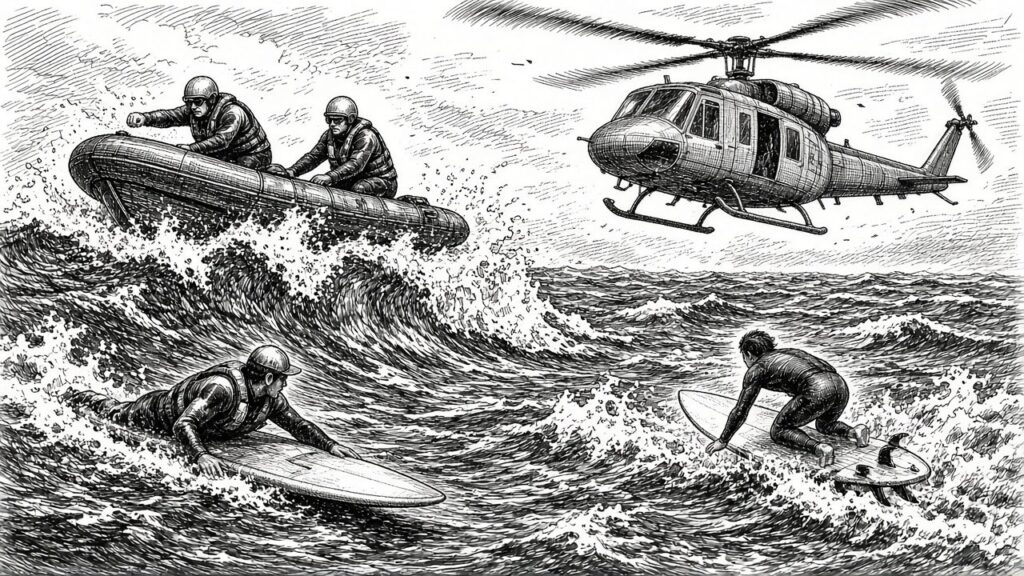
Avalon lifesaver Warren Mitchell came home from lifeguarding in England sure an inflatable boat could beat the reel. He trialled one on 2 November 1969 with his brother Don as crew. In December 1969 he used it to pull eight people from a rip, the first rescue by an inflatable rescue boat. Traditionalists were sceptical, but the boat was approved for club use in 1970. IRB racing became a surf sport from 1976.
The sky came next. On 29 September 1973, with one Bell 47 helicopter and backing from the Bank of New South Wales (now Westpac), surf lifesaving launched what it calls Australia’s first integrated civilian helicopter rescue service. By its 50th birthday in 2023 there were 15 Westpac rescue helicopters. Jet skis, officially rescue water craft, joined Queensland’s surf lifesaving service in 1999.
Then came television. Bondi Rescue, which follows Waverley’s paid lifeguards through the summer, has screened on Network 10 since 2006. Former lifeguard Ben Davies came up with it, and Waverley’s library says it now airs in 100 countries.
Still between the flags
The clubs have always been more than a rescue service. Plenty of members join for the racing and the clubhouse. They’ve had lean years, too: when boardriding boomed in the 1960s, membership fell and some clubs faced closure. The flags still matter. In 2024–25, volunteer surf lifesavers and the Australian Lifeguard Service performed 8,207 rescues. Of the 154 people who drowned on the Australian coast that year, every one was outside the flags, outside patrol hours or at an unpatrolled spot. So, swim between the flags.
Stories you probably haven’t heard
Surf-bathing in skirts
In 1907 Waverley Council decided neck-to-knee wasn’t enough and wanted a short-sleeved tunic on top. Bondi’s men protested by turning up in a draughts-board outfit with a knee-length skirt, frilly knickers and even a Roman centurion’s costume. The centurion found his skirt dangerous in the water. The rule didn’t last.
Bear suits
After the Second World War, surplus RAAF flying-suit linings turned up in the stores. Lifesavers wore them fur side out on cold patrols, and to dances. They were known as bear suits.
Flag Corner
See it for yourself. Every video here is an official upload from the channel that made it or holds it. No bootlegs, no rips.
Sources
- National Museum of Australia, “The birth of surf lifesaving” (Between the Flags), including timeline, flags, caps, women, Nippers: https://www.nma.gov.au/exhibitions/between-the-flags/birth-of-surf-lifesaving
- National Museum of Australia, “First lifesaving club” (Defining Moments): https://www.nma.gov.au/defining-moments/resources/first-lifesaving-club
- National Museum of Australia, “Discovering the beach”: https://www.nma.gov.au/exhibitions/between-the-flags/discovering-beach
- National Museum of Australia, “Tools and techniques” (surf reel): https://www.nma.gov.au/exhibitions/between-the-flags/tools-techniques-archived
- National Museum of Australia, “Competition in the surf”: https://www.nma.gov.au/exhibitions/between-the-flags/competition-in-surf-archived
- Australian Dictionary of Biography, “Gocher, William Henry”: https://adb.anu.edu.au/biography/gocher-william-henry-6408
- Surf Life Saving NSW, “Our History”: https://www.surflifesaving.com.au/about-us/our-history/
- Surf Life Saving NSW, “When Were Women Finally Given A Start?” (excerpt from Evolution of an Icon): https://www.surflifesaving.com.au/news/throwback-when-were-women-finally-given-start/
- Surf Life Saving NSW, “The Rubber Duckie Turns 50” (2019): https://www.surflifesaving.com.au/news/rubber-duckie-turns-50/
- Surf Life Saving Australia, “National Coastal Safety Report 2025” release: https://sls.com.au/surf-life-saving-australia-releases-national-coastal-safety-report-2025/
- Surf Life Saving Queensland, Rescue Water Craft SOPs: https://lifesaving.com.au/app/uploads/Rescue-Water-Craft-SOPs.pdf
- Westpac Life Saver Rescue Helicopter, “Iconic Westpac Lifesaver Rescue Helicopter Service turns 50” (2023): https://lifesaver.org.au/iconic-westpac-lifesaver-rescue-helicopter-service-turns-50/
- NSW Environment and Heritage, Blue Plaques: Bondi Surf Bathers Life Saving Club: https://www.environment.nsw.gov.au/topics/heritage/blue-plaques/establishment-of-the-first-surf-life-saving-club
- Bondi Surf Bathers’ Life Saving Club, “The Beginning of the Club”: https://bondisurfclub.com/the-club/history/the-beginning-of-the-club/
- Bondi Surf Bathers’ Life Saving Club, “Black Sunday”: https://bondisurfclub.com/the-club/history/black-sunday/
- Bronte Surf Life Saving Club, “About Us”: https://brontesurfclub.com.au/about-us
- Manly Council, “Manly Heritage & History”: https://manlycouncil.info/council/about-manly/manly-heritage–history/index.html
- Waverley Council Library, “Surf Life Saving Reel”: https://celebrating.waverley.nsw.gov.au/nodes/view/73583
- Waverley Council Library, “Denis ‘Dinny’ Brown”: https://celebrating.waverley.nsw.gov.au/nodes/view/73579
- Waverley Council Library, “March Past”: https://celebrating.waverley.nsw.gov.au/nodes/view/73334
- Waverley Council Library, “Bondi Rescue”: https://celebrating.waverley.nsw.gov.au/nodes/view/73570
- Waverley Council Library, “1907 Bathing Costume Protests”: https://celebrating.waverley.nsw.gov.au/nodes/view/73059
- Australian War Memorial, “Winners of the march past at the Gaza Beach surf lifesaving carnival” (c. September 1941): https://www.awm.gov.au/collection/C30635
- Australian Institute for Disaster Resilience, “Bondi’s Black Sunday, New South Wales 1938”: https://knowledge.aidr.org.au/resources/maritimecoastal-bondis-black-sunday-new-south-wales-1938/
- The Canberra Times, “Bondi Surf Tragedy”, 7 February 1938 (via Trove): https://trove.nla.gov.au/newspaper/article/2451810
- National Film and Sound Archive, “History of surfing and surf movies in Australia”: https://www.nfsa.gov.au/latest/history-surfing-and-surf-movies-australia
- Australian Screen (NFSA), “Bondi Rescue”: https://aso.gov.au/titles/series/bondi-rescue/
- Sydney Morning Herald, “Nippers clubs booming 50 years from inception” (2015): https://www.smh.com.au/national/nsw/boys-and-girls-of-summer-20151130-glb8wn.html
- Sydney Morning Herald, “When daylight swimming was illegal at Manly beach” (2024): https://www.smh.com.au/sport/when-daylight-swimming-was-illegal-at-manly-beach-20240503-p5fomp.html
- Geoff Cater, surfresearch.com.au, “Duke Kahanamoku’s Australian Tour, 1914-1915” (quotes the 1914-15 Sydney press): https://www.surfresearch.com.au/1914_Duke.html
No press or archive photos are used. Illustrations are original black-and-white ink artwork by Gidget for Surfing Fukcs, with invented adult characters, not likenesses of real people, and no logos. Videos are embedded from the official YouTube channels named in each caption.