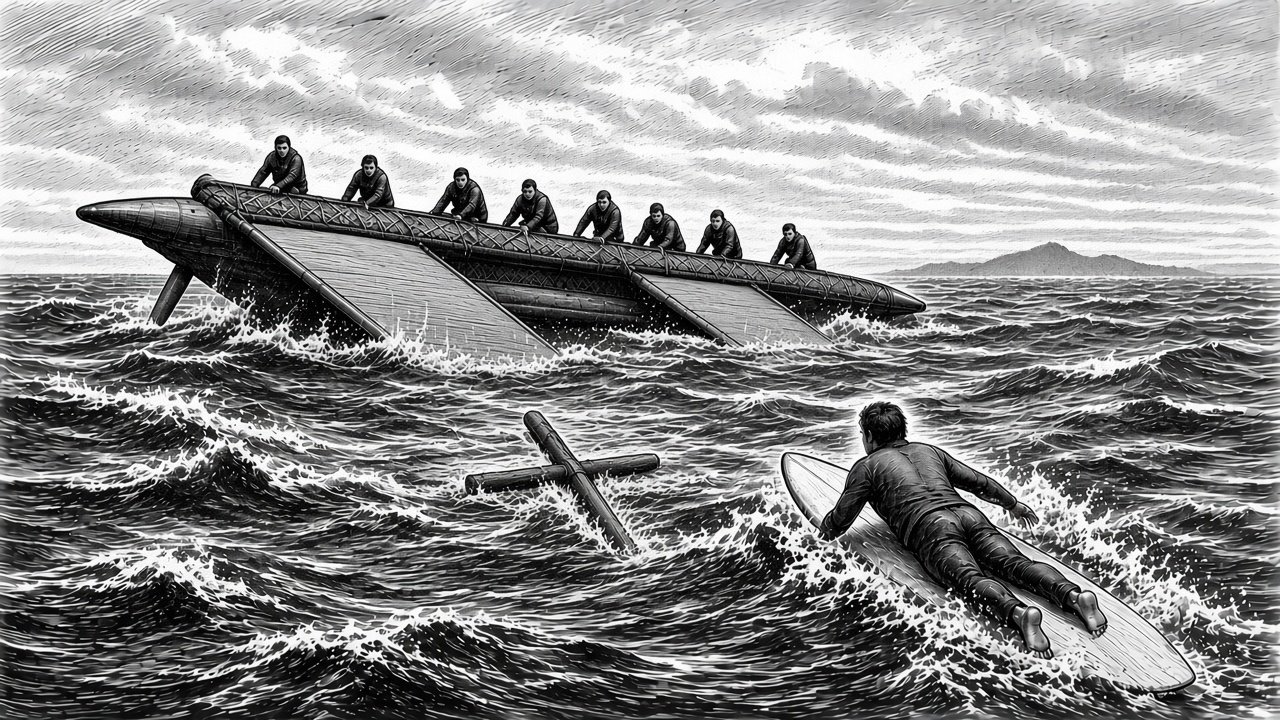
On the North Shore of Oʻahu there is a three-word phrase you will find on bumper stickers, T-shirts, surf wax and the occasional tattoo: Eddie Would Go. It sounds like a dare. It started as a description of a man. Eddie Aikau was a lifeguard who swam into surf that sent everyone else up the beach, a big-wave rider who won one of Hawaiʻi’s biggest contests, and a crewman who paddled away from a capsized voyaging canoe to get help for his friends. Here is his story, and the story of the family and the contest that keep it alive.
From Kahului to Pauoa Valley
Edward Ryon Makuahanai Aikau was born on May 4, 1946, in Kahului, Maui, one of six children of Solomon “Pops” and Henrietta Aikau. In 1959 the family moved to Oʻahu and settled in Pauoa Valley, above downtown Honolulu. Eddie took to the waves at Waikīkī, and he later taught his kid brother Clyde, three years younger, to surf there too. The two would be close for the rest of Eddie’s life, in the water and out of it: friends remember them most for the slack key guitar sessions they would break into wherever the family gathered.
The first guard at Waimea Bay
In 1968 the City and County of Honolulu hired Eddie as its first lifeguard on the North Shore, and he was posted to Waimea Bay. That took a little bending of the rules: he had no high-school diploma, and Clyde later recalled that Eddie needed an exemption to get the job. Nobody seems to have regretted it.
Waimea in winter is a bay where the waves can stand taller than a house and the shorebreak can knock grown adults flat. Eddie is credited with more than 500 rescues there, and no one drowned at Waimea while he was on duty. The real number may be higher. According to the Polynesian Voyaging Society’s account, he rarely bothered to fill in rescue reports. In 1971 his fellow lifeguards voted him Lifeguard of the Year. Clyde later joined him on the Waimea towers and told the Star-Advertiser that, on busy days, the two of them could make 30 to 50 rescues between them.

Big waves, a big win
When the swell came up, the lifeguard became one of the boldest riders in the bay. Eddie was a fixture in the big-wave era of the late 1960s and 1970s. He made the final of the Duke Kahanamoku contest six times, and he placed fifth in the 1971 Smirnoff Pro, fourth in 1972 and third in 1976.
His biggest win came on December 10, 1977, when he took the Duke Kahanamoku contest at Sunset Beach. The event was named for the Olympic swimmer and father of modern surfing, so for a Hawaiian waterman there was hardly a better trophy to lift. Brother Clyde had won the same contest in 1973. Barely three months after Eddie’s win, he signed on for a very different kind of adventure.
Hōkūleʻa, March 1978
Hōkūleʻa is a double-hulled Polynesian voyaging canoe built by the Polynesian Voyaging Society to show that ancient navigators could sail the Pacific on purpose, steering by stars, swells and birds. In 1976 she sailed from Hawaiʻi to Tahiti under the Micronesian master navigator Mau Piailug. The 1978 voyage was meant to go back to Tahiti, navigating without instruments again, and to test new lauhala sails and preserved food along the way. Eddie, a proud Hawaiian who cared deeply about his culture, joined the crew of sixteen.
They left Ala Wai Harbor at 6:30 p.m. on March 16, 1978. The trade winds were blowing around 30 knots and a gale warning was in effect. The heavily loaded canoe began taking on water, and around midnight, about five hours out in the channel between Oʻahu and Molokaʻi, she swamped and capsized. The crew spent the night clinging to the overturned hulls.
Morning brought no rescue. Another crewman had tried to set out on a surfboard and turned back. Eddie asked the captain twice to let him paddle for help and was told no. Mid-morning on March 17 he got permission. He carried a life jacket, flares and safety gear, and the plan was to head for Molokaʻi and let the current carry him toward Lānaʻi if he missed. The crew prayed together, and then he paddled off. “When [Eddie] paddled away, I really thought he was going to make it and we weren’t,” one of his crewmates told the Honolulu Advertiser 30 years later. It was the last time anyone saw him.
That evening, around 8:47 p.m., the pilot of the last Hawaiian Airlines flight from Kona spotted the crew’s flares. A Coast Guard helicopter found the canoe at 9:27 p.m., and the crew was rescued in the early hours of March 18. The search for Eddie went on by air and sea until March 23. A civilian helicopter reported seeing a surfboard on March 18, but the seas were too rough to reach it. Eddie Aikau was 31.
Navigator Nainoa Thompson, who was aboard that night, has spent a lifetime thinking about it. “He was a lifeguard,” Thompson said. “He guarded life, and he lost his own, trying to guard ours.”
Sailing on
Hōkūleʻa did sail again. After 1978 the Voyaging Society required an escort boat on long voyages, added watertight hatches and toughened its safety training. In 1980 Thompson navigated Hōkūleʻa to Tahiti without instruments, the first Native Hawaiian in about 600 years to do it. When Thompson carried guilt over that night, Clyde would cut him off. “Nainoa, stop,” Thompson remembers him saying. “That’s not what Eddie wants.”
So who said “Eddie Would Go”?
It depends on who you ask, and that’s half the fun. Lifeguard Mac Simpson, quoted in the Voyaging Society’s archive, says the phrase “Eddie would go” was around before Hōkūleʻa ever sailed. Another version, told in Stuart Coleman’s biography, sets it at the 1986 memorial contest: with organizers worried that the windblown Waimea surf was too dangerous, big-wave rider Mark Foo said, “Eddie would go.” The Encyclopedia of Surfing describes it as a slogan launched by Quiksilver in the late 1980s to promote the event. All three can be true at once. What isn’t in dispute is where it went next: by the 1990s the phrase had escaped surfing entirely and come to mean doing the hard, brave, right thing.
The Eddie
The memorial contest, the Quiksilver in Memory of Eddie Aikau, was first held at Sunset Beach on January 3, 1985, in waves of 6 to 8 feet, and Denton Miyamura won. On February 23, 1986, it moved to Eddie’s home break. In roughly 25-foot surf at Waimea, Clyde Aikau, 36, won it, riding a board of his brother’s that was about ten years old. It is hard to write a better ending than that, and nobody has tried.
The Eddie has one famous rule: it only runs when Waimea’s waves hold at 20 feet on the Hawaiian scale, roughly 40-foot faces, all day. So most winters it waits and doesn’t go. Through December 2024 it had been held only 11 times in four decades. The honour roll includes Keone Downing (1990), Noah Johnson (1999), Australian Ross Clarke-Jones (2001, the first winner from outside Hawaiʻi), Kelly Slater (2002), Bruce Irons (2004), Greg Long (2009) and John John Florence (2016).
Clyde kept paddling out. He surfed the 2016 event at 66, the oldest competitor in its history. He hurt his right shoulder on his first wave, paddled the rest of the day with his left arm, and called it “one dirty lickins.” He finished 21st.
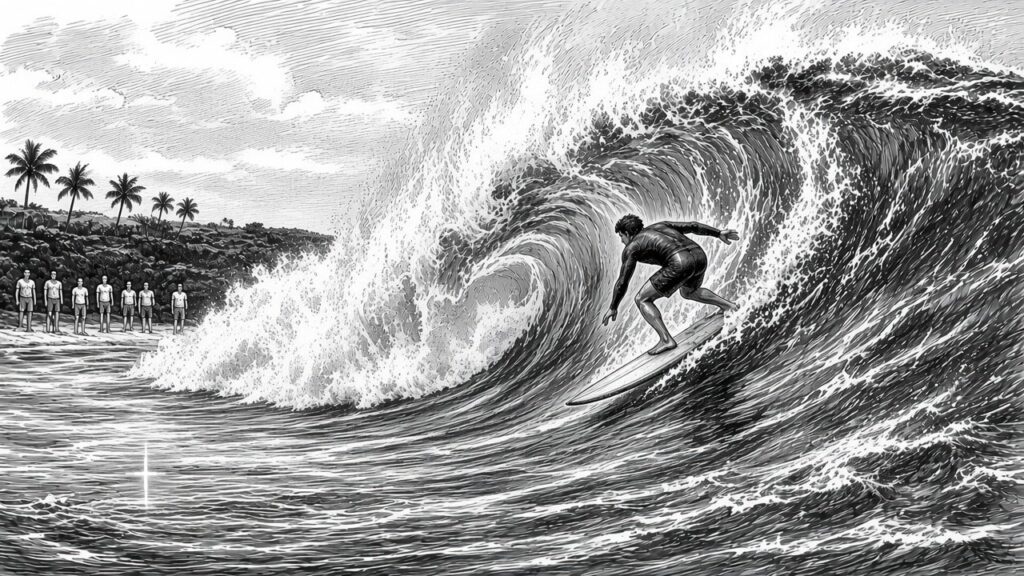
The January 22, 2023, contest gave the story a twist Eddie would have loved. City and County Ocean Safety lifeguard Luke Shepardson, working a tower that day, won it, scoring 89.1 out of a possible 90. That year women were invited for the first time, and Andrea Moller became the first woman to ride a wave in competition. On December 22, 2024, Landon McNamara won in front of his father, contest director Liam McNamara.
Sponsors have changed along the way. Quiksilver’s long run ended after the 2016 contest, and the event is now the Rip Curl Eddie Aikau Big Wave Invitational. Each winter season opens with a ceremony, and then the waiting begins. The 2025–26 holding period closed on March 6, 2026, without the waves to run, which is the Eddie working exactly as designed.
The family and the legacy
For almost half a century Clyde was the keeper of his brother’s memory: competing, speaking, sailing on Hōkūleʻa himself from 1995, and keeping the contest true to Eddie. He died peacefully at his Waimānalo home on May 3, 2025, at 75, and was honored at the December 2025 opening ceremony. The Aikau family created the Eddie Aikau Foundation in May 2000. Through its Eddie Would Go Essay Contest it gives awards to Hawaiʻi students to encourage them in their education, with a special interest in Hawaiian heritage and language.
The honors have stacked up. Eddie was inducted into the Surfing Walk of Fame in Huntington Beach as a Surf Pioneer in 2000 and into the Hawaii Waterman Hall of Fame in 2010. Coleman’s biography, Eddie Would Go, came out in 2002. In 2013 the documentary Hawaiian: The Legend of Eddie Aikau, directed by Sam George, narrated by Josh Brolin and produced by Stacy Peralta, premiered at the Tribeca Film Festival and aired on ESPN’s 30 for 30 that October 1.
Stories you probably haven’t heard
The surfboard was an heirloom
Clyde’s 1986 win at Waimea came on one of Eddie’s own boards, already about a decade old. It is about as close as a brother can come to surfing a heat together.
Lifeguard on the clock
Luke Shepardson won the 2023 Eddie while working as an Ocean Safety lifeguard. He was on duty as a lifeguard that same day, contest or no contest. Waimea’s first lifeguard would have approved.
The airliner that found them
Hōkūleʻa’s crew was spotted at night not by a search plane but by the pilot of a routine Hawaiian Airlines flight from Kona, who saw their flares and reported them.
Eddie Would Go Corner
Pull up a chair. Every video here is an official upload from the channel that made it or runs the event, and every one allows embedding. No bootlegs, no rips.
Sources
- Polynesian Voyaging Society archive, “Eddie Aikau” (biography, Eddie Aikau Foundation text and recollections): https://archive.hokulea.com/index/founder_and_teachers/eddie_aikau.html
- Polynesian Voyaging Society archive, “1978: Voyage Cancelled”: https://archive.hokulea.com/holokai/1978/voyage_cancelled.html
- Polynesian Voyaging Society archive, “1978”: https://archive.hokulea.com/1978.html
- Polynesian Voyaging Society archive, Ben Finney, “1980 Hawai’i to Tahiti and Back”: https://archive.hokulea.com/holokai/1980/ben_finney.html
- Hōkūleʻa / Polynesian Voyaging Society, “Nainoa Thompson”: https://hokulea.com/crewmember/nainoa-thompson/
- Eddie Aikau Foundation, “Our History”: https://www.eddieaikaufoundation.org/our-history
- Honolulu Star-Advertiser, “Eddie Aikau: Beyond the legend” (2013): https://www.staradvertiser.com/2013/06/09/features/eddie-aikau-beyond-the-legend-2/
- Honolulu Star-Advertiser, “Funding likely to determine whether The Eddie will still go” (2018, with contest timeline): https://www.staradvertiser.com/2018/01/07/hawaii-news/funding-likely-to-determine-whether-the-eddie-will-still-go/
- Honolulu Star-Advertiser, “Honolulu lifeguard Luke Shepardson wins The Eddie contest” (2023): https://www.staradvertiser.com/2023/01/22/sports/sports-breaking/honolulu-lifeguard-luke-shepardson-wins-the-eddie-contest/
- Honolulu Star-Advertiser, “Women join men in the lineup for historic Eddie surf contest” (2023): https://www.staradvertiser.com/2023/01/22/hawaii-news/women-join-men-in-the-lineup-for-historic-eddie-surf-contest/
- Honolulu Star-Advertiser, “North Shore huge waves bring power, respect and danger” (2024): https://www.staradvertiser.com/2024/12/22/hawaii-news/north-shore-huge-waves-bring-power-respect-and-danger/
- Honolulu Star-Advertiser, “Waterman Clyde Aikau had a ‘joyous’ way of life” (2025): https://www.staradvertiser.com/2025/05/06/hawaii-news/waterman-clyde-aikau-had-a-joyous-way-of-life/
- Honolulu Star-Advertiser, “Eddie is a no-go with season holding period ending today” (2026): https://www.staradvertiser.com/2026/03/06/sports/sports-breaking/eddie-is-a-no-go-with-season-holding-period-ending-today/
- Encyclopedia of Surfing, “1977 Duke Kahanamoku Surfing”: https://www.eos.surf/contest/1977-duke-kahanamoku-surfing
- Encyclopedia of Surfing, “Hokule’a capsizes; one missing” (Honolulu Star-Bulletin, 1978): https://www.eos.surf/feature/hokulea-capsizes;-one-missing-honolulu-star-bulletin-1978
- Encyclopedia of Surfing, “Eddie Would Go”: https://www.eos.surf/encyclopedia/eddie-would-go
- HAWAIʻI Magazine, “The Profound Significance Behind ‘Eddie Would Go’” (2016): https://www.hawaiimagazine.com/the-profound-significance-behind-eddie-would-go/
- Surfing Walk of Fame, “Eddie Aikau”: https://surfingwalkoffame.com/eddie-aikau/
- Duke Kahanamoku Foundation, Hawaii Waterman Hall of Fame, “Eddie Aikau”: https://www.dukefoundation.org/inductee/eddie-aikau
- ESPN Press Room, “Hawaiian: The Legend of Eddie Aikau to premiere October 1 on ESPN” (2013): https://espnpressroom.com/press-release/the-second-volume-of-espn-films-30-for-30-series-returns-with-hawaiian-the-legend-of-eddie-aikau-to-premiere-october-1-on-espn/
- Tribeca Film, “Hawaiian: The Legend of Eddie Aikau” (2013 festival): https://tribecafilm.com/festival/archive/51471ed0c07f5d4659000002-hawaiian-the-legend-of-ed
- Rip Curl, “2024 Rip Curl The Eddie Big Wave Invitational in Memory of Eddie Aikau Highlights” (YouTube): https://www.youtube.com/watch?v=XIFpS5kARYQ
No press or archive photos are used. The illustrations are original black-and-white ink drawings for Surfing Fukcs, showing invented, anonymous figures rather than likenesses of real people, with no logos. Videos are embedded from the official YouTube channels named in each caption.