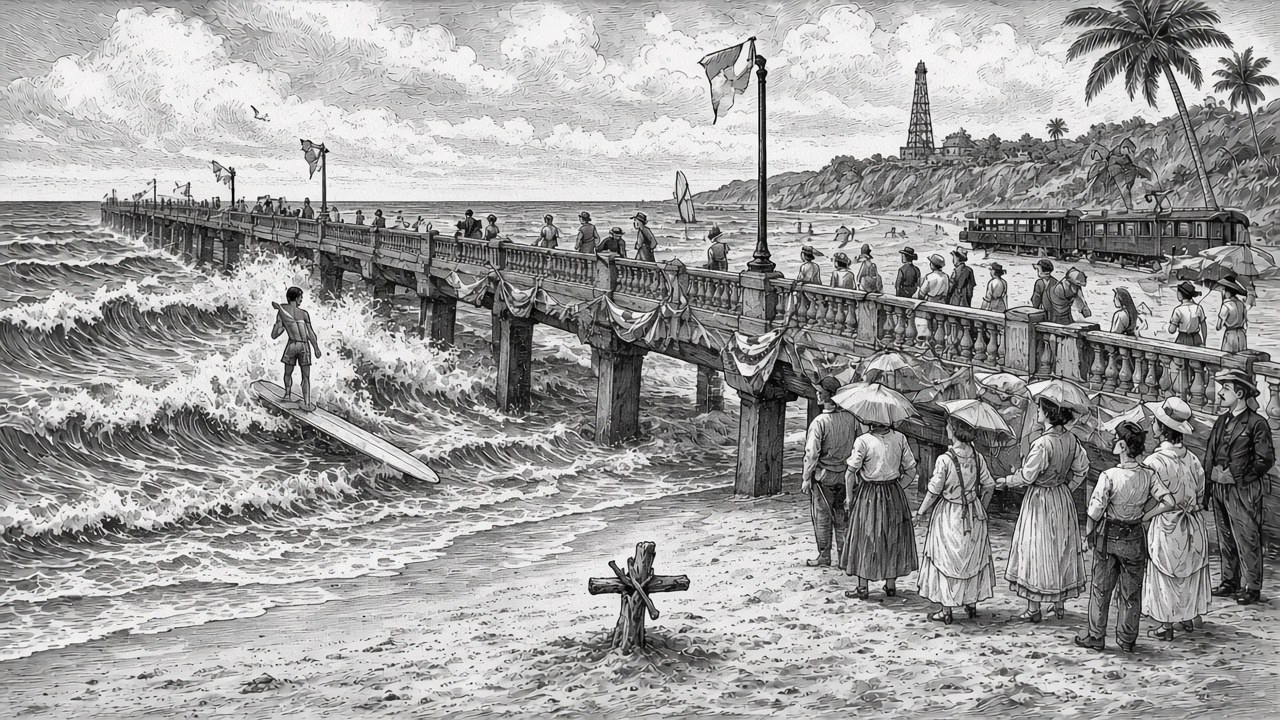
Before the trademark lawyers and the T-shirt wars, Huntington Beach was a muddy Pacific Electric stop with a wooden pier and big plans. In June 1914, the town threw a party for its brand-new concrete pier, and a Hawaiian-Irish waterman named George Freeth stood up on a heavy board in front of the crowd. A century of contests, songs, statues and lawsuits later, the town owns the words “Surf City USA,” legally.

The facts, no wax on top
- Pacific City first. In 1901, developers launched a resort they called Pacific City and pitched it as an Atlantic City for the West Coast. After Henry E. Huntington bought in and ran his Pacific Electric line down from Long Beach in 1904, the town took his name.
- The wooden pier. The first pier was a timber structure about 1,000 feet long. The National Register nomination dates it to 1903 and the city to 1904. Storms battered it until voters approved a $70,000 bond for a replacement.
- The concrete pier. The new pier at the foot of Main Street was dedicated on Saturday, June 20, 1914. At the time it was billed as the longest and highest concrete pleasure pier in the country. Its length is given as anywhere from 1,316 to 1,350 feet, depending on the record.
- Freeth’s demo. The dedication program had kids’ foot races, a baseball game, a swim show by the Los Angeles Athletic Club, an evening “Ocean Illumination Show” and a special surfing demonstration by George Freeth. The city’s tourism bureau says Huntington himself invited Freeth.
- Oil, then highway. Oil was discovered in 1920 and turned the farm town into a boomtown. Pacific Coast Highway arrived in 1925 and opened up 8.5 miles of beach.
- The pier keeps getting rebuilt. It was extended by about 500 feet in 1930. A 1939 storm took out the end and the cafe. The Navy used it for submarine watch in World War II. Storms smashed it in 1983, and on Jan. 18, 1988, storms ripped off the end 250 feet. The pier was declared unsafe in July 1988 and rebuilt, then reopened in July 1992.
- Surf shops move in. Gordie Duane opened Gordie’s Surf Boards under the pier in 1956. Jack Hokanson’s Jack’s Surfboards followed at PCH and Main in 1957.
- The contest. The first West Coast Surfboard Championships ran in September 1959, with about 75 entrants (the library says 73). It became the U.S. Surfboard (or Surfing) Championships in 1964, the OP Pro in 1982 and the U.S. Open of Surfing in 1994.
- The trademark. The visitors bureau filed for “Surf City USA” in 2004 and registered it in May 2006. After a fight with a Santa Cruz T-shirt shop, a confidential January 2008 settlement left Huntington Beach with exclusive rights.
Stories you probably haven’t heard
Shooting it twice. Jack Haley won the men’s division at that first 1959 contest, and Linda Benson won the women’s. According to the city, Haley shot the pier, turned around and “unshot” it on the same ride.
Pepsi got there first. Per Matt Warshaw’s history, Pepsi signed on in 1962, the first multinational company to sponsor a surf contest. ABC’s Wide World of Sports broadcast the 1964 Championships. Contestants had to wear hard-plastic crash helmets.
The song that sealed it. Jan and Dean’s “Surf City” hit No. 1 in the summer of 1963, and Warshaw calls it a tribute to the good life at Huntington. When the trademark fight came, Santa Cruz’s mayor went on local TV singing his own protest version. Dean Torrence answered that when they wrote it, “none of us had Santa Cruz in mind.”
The Sacramento skirmish. In 2005 a Santa Cruz-area state senator introduced a resolution to name his city “Surf City USA,” then withdrew it after Huntington Beach officials lobbied in Sacramento. The real lawsuit started with a cease-and-desist letter in September 2006 to a Santa Cruz wharf shop. In the end, the shop’s shirts were redesigned to read “Surf City Santa Cruz, Calif., USA, Original.” As the shop owner said, “we have to share the Pacific Ocean.”
Duke in bronze. Duke Kahanamoku has a life-size bronze statue at PCH and Main, created by Edmond Shumpert in 2001. The handprints and footprints of the Surfers’ Hall of Fame surround it. Across the street, the Surfing Walk of Fame has been adding stones since 1994. The International Surfing Museum, founded in 1987, keeps a Duke hardwood board and Dick Dale’s first electric guitar.
Pier riot. Not every contest was sunshine. The 1986 OP Pro ended in a riot on the sand, and the library’s own history calls it “ill-fated.”
Last call
A pier party, an oil boom, a No. 1 hit and a federal lawsuit: Surf City earned the name the long way. Walk out past the 1914 cornerstone’s old spot, look south toward the contest peak and tip your hat to the guy on the plank who started it.
Surf City Corner
Straight from the town itself. Official uploads only, no rips.
Sources
- Huntington Beach Public Library, “The Huntington Beach Pier” (historic photo exhibit, part 7): https://hbpl.libguides.com/main-street-branch/historic-photo-exhibits-part-7
- Huntington Beach Public Library, “Huntington Beach Surfing Legacy” (part 8): https://hbpl.libguides.com/main-street-branch/historic-photo-exhibits-part-8
- City of Huntington Beach, pier reconstruction history (historical files): https://cms3.revize.com/revize/huntingtonbeachca/Documents/Departments/Library/Contact%20Us%20About/Historical%20Files/Historical%20Files%20Pier%20and%20Surfing/071029-4.pdf
- National Register of Historic Places, Huntington Beach Municipal Pier nomination: https://npgallery.nps.gov/GetAsset/fde85b63-b438-4298-9ef0-1063bc28be18
- City of Huntington Beach, “HB Pier: A Long History”: https://www.huntingtonbeachca.gov/news_detail_T4_R476.php
- City of Huntington Beach, “Celebrating Surf Heritage: US Open of Surfing History”: https://www.huntingtonbeachca.gov/news_detail_T4_R125.php
- Visit Huntington Beach, “100 Years of Surfing”: https://www.surfcityusa.com/things-to-do/surfing/100-years-of-surfing/
- Visit Huntington Beach, US Open of Surfing: https://www.surfcityusa.com/events/annual-events-festivals/us-open-of-surfing/
- Los Angeles Times, “Huntington Beach Pier Chronology” (1988): https://www.latimes.com/archives/la-xpm-1988-07-13-me-5516-story.html
- Los Angeles Times, “‘Surf City’ is stoked” (2008): https://www.latimes.com/archives/la-xpm-2008-jan-28-me-surfcity28-story.html
- Santa Cruz Sentinel via Reference.org, “It’s official: Santa Cruz is not Surf City USA” (2008): https://reference.org/news/Santa+Cruz%2C+California/F4vbqpob
- SURFER, “Before the U.S. Open was the U.S. Open”: https://www.surfer.com/news/history-of-us-open-huntington
- World Surf League, “Break Breakdown: Andersen’s Surf City, USA” (2015): https://www.worldsurfleague.com/posts/123073/break-breakdown-2015-vans-us-open-of-surfing
- Huntington Surf & Sport, Surfers’ Hall of Fame: https://www.hsssurf.com/pages/shof
- Wikipedia, “Surf City USA” (for the 2004 filings and 2005 resolution; checked against the LA Times above): https://en.wikipedia.org/wiki/Surf_City_USA
Illustration is original Surfing Fukcs artwork with invented characters, not a likeness of George Freeth or anyone else.